FL privacy benchmark
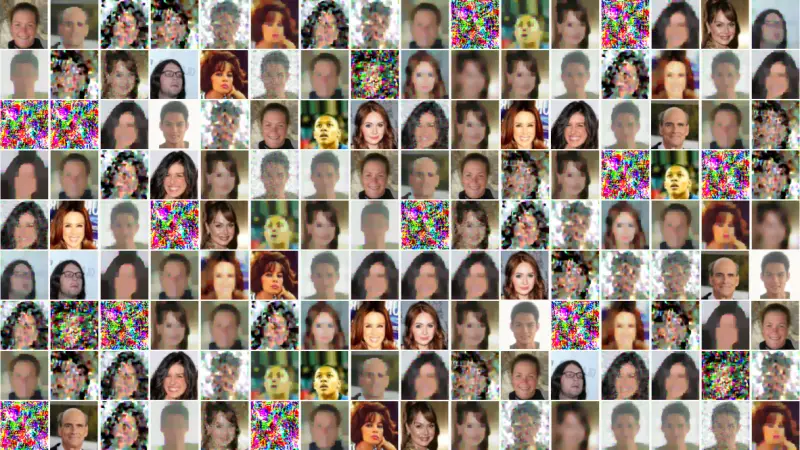
A benchmark that measures how much private training data leaks from federated learning updates. A gradient inversion attack rebuilds recognisable faces from one client's update, and the benchmark tests whether differential privacy and an encryption-style defence stop it.
The question
Federated learning keeps training data on each client and only shares model updates. The usual claim is that this keeps the data private. A gradient inversion attack tests that claim: it starts from noise and optimises an image until its gradient matches the gradient the client sent.
What the benchmark does
It simulates federated training on 64×64 CelebA faces with a model of about 8.76 million parameters, captures a single client’s gradient before aggregation and attacks it. Then it repeats the attack with defences switched on.
| Configuration | PSNR (dB) | LPIPS, lower is closer |
|---|---|---|
| No defence | 29.38 | 0.117 |
| Local DP, ε = 1 | 6.32 | 0.747 |
| Quantise + noise (“HE” setting) | 14.03 | 0.635 |
| Local DP, ε = 1, plus “HE” | 6.37 | 0.824 |
Without a defence, the attack rebuilds faces you can recognise from one update. With local differential privacy, the reconstructions turn to noise.
What the numbers do not prove
The repository write-up is explicit about the limits.
- Every ε looks the same. ε = 8, 1 and 0.1 all land between 6.3 and 6.7 dB. That is not a bug. With 8.76 million parameters, the Gaussian noise grows with the square root of the dimension, so even ε = 8 already swamps the signal. The chosen range could never have shown graduated protection.
- The “HE” row is not encryption. At this model size the code quantises the gradient and adds fixed noise. It never runs real Paillier encryption, and a real secure aggregation setup would never hand the attacker a decrypted update.
- Utility is not measured. The benchmark measures attack quality only, so it says nothing about how much accuracy each defence costs.
The live dashboard has the full reconstructions and ablations.